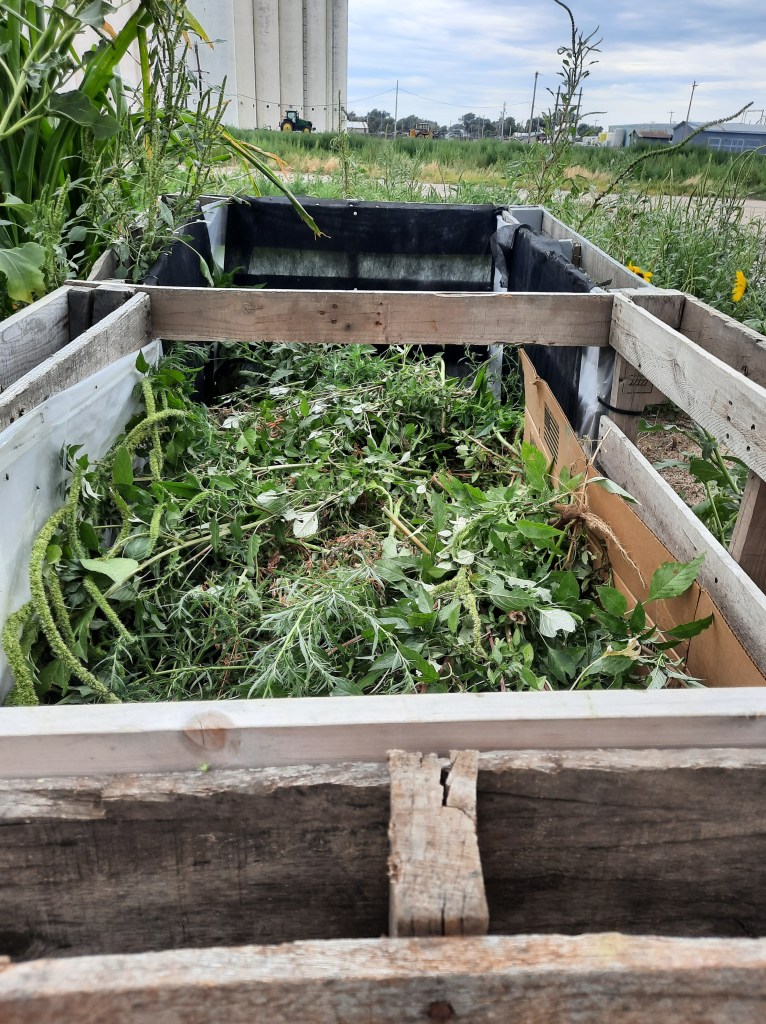
More on the compost bin.

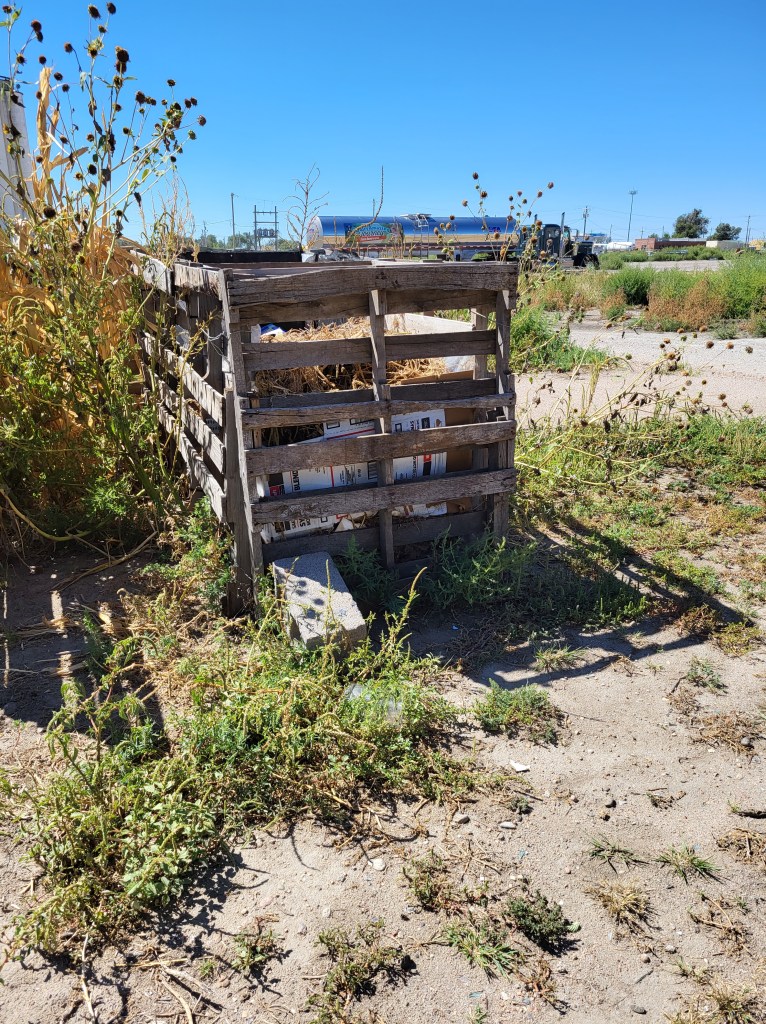
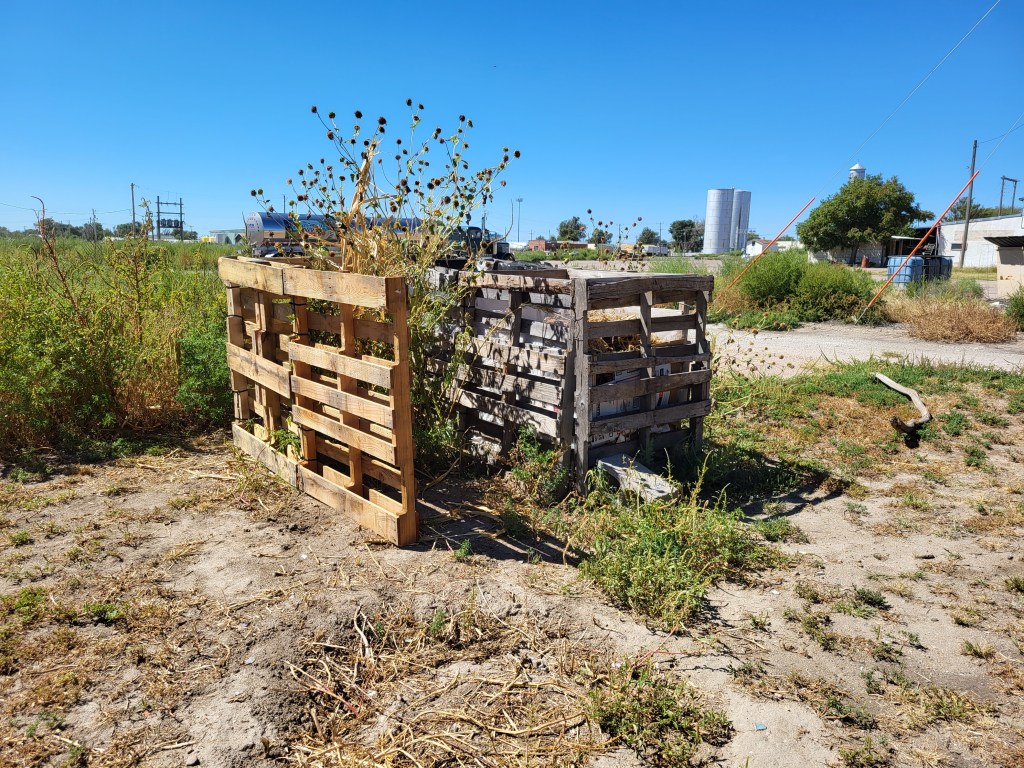
As you may already know, I built a compost bin from six pallets.

I got the idea from Mike from Sustainable Me on youtube.

For now, I just have the one bin, the setup he showed had three, and I’m headed that way. As soon as I harvest the corn, I’ll put up the second part and turn the first bin into the second and start filling the first again.

The third bin is to hold the finished compost.

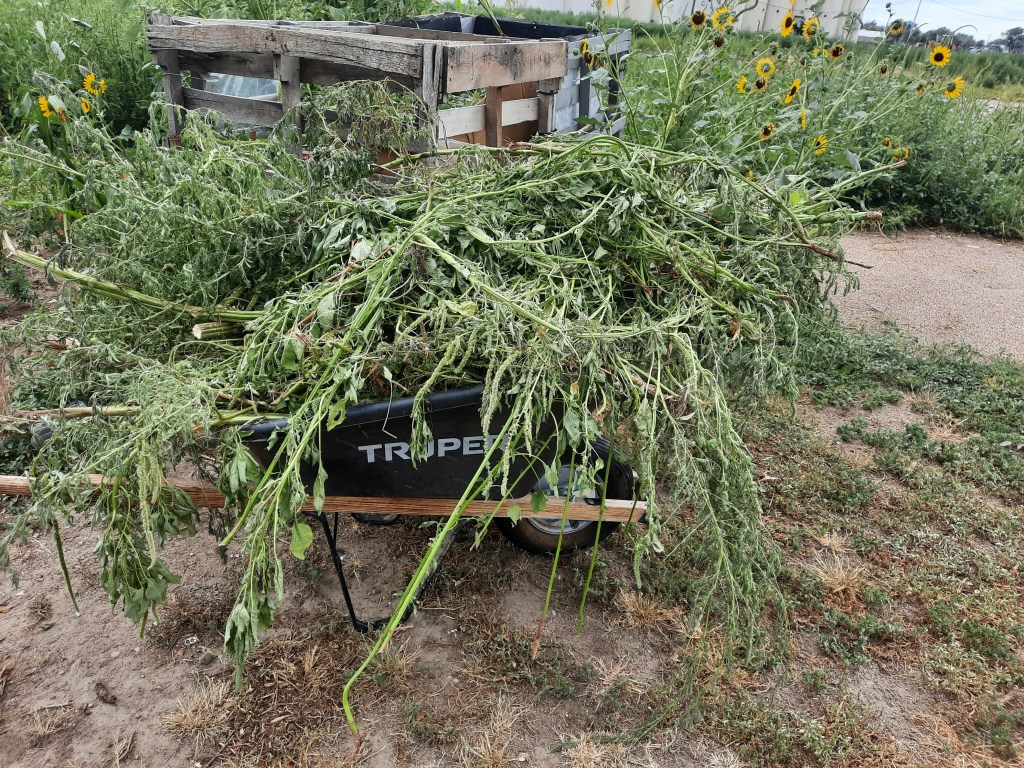
Wheelbarrow filled with weeds.

I recently acquired a wheelbarrow. It was in disrepair and about to fall apart. However, I got some longer bolts and some heavy-duty flat washers from car shocks. And bolted it back together.

This makes it easier to do much more work faster and should last at least for a while. After the yard work of Fall is done, I’ll take it all apart, sand and stain the wood, and fix the wheel so it doesn’t slide from side to side.

I put a hose clamp on each side to hold it in place for now, but I will cut pieces of tubing to slide over the shaft.

I’ll use my plastic welder to fix up the cracks in the tub, and it should serve us for many years to come.

Compost bin getting full, again.

I turned another old bin into this one and covered it with a layer of carboard, and now I’m topping the bin off.

The bin is full, again.

This makes the third time I have had this filled to the top. I’ll mow up most of the rest of the weeds and top the bin off with that, I’ll also put some grass clipping on it as well.

What’s left over will be used to fill more containers and a raised bed or two as Hugelkultur material. Anything left over will be thrown into a pile to break done over Fall and Winter.

With all the rain we’ve been getting, everything is growing like crazy. I’ve gotten more material for composting than I have in decades.

It’s a bit overwhelming at times, but I think having more material to compost is a good problem to have. It will rot and become soil sooner or later, even if I just pile it up and forget about it. So, there is no real way to lose.

I’m hopeful that I will have enough compost that is suitable for seed starting by January. I will likely start all of my own plants and have some to sell.

Last January, I started a little over 1K plants. Many didn’t make it, but many did. I plan on selling some come Spring. How many or what kinds, I’ve not decided just yet, but with my new and improved rack for plant starting. I should be able to easily start 2K if not more.

May your ventures be met with sucess.

https://rodaleinstitute.org/blog/backyard-composting-basics-a-cheatsheet/

Sometimes, it’s the little things.

Ladd Beater No. 2 dated 1921.

  I went to the local thrift shop the other day. I went looking for something for someone else and stumbled across this.

  When I picked it up, I was trasported back in time and was once again standing on a foot stool in my grandmas kitchen helping her cook. So many memories came flooding back to me.

  I had to have it, it wasn’t marked with a price, but I didn’t care.

  Turns out I got it for $1, and I couldn’t be happier.

  I’m constantly moving towards a lifestyle that doesn’t require anything fancy to have what I want.  Doing things the old way draws me in a way I can not explain other than to say I feel a need to learn and do as much as I can without electricity.

  I’m teaching the boys how to do things the old ways as well. They probably won’t be overly excited for these once they use them to prepare something but seem to think they are great fun to play with.

While I certainly do not know if we are headed towards an economic collapse and hard times, many predict that we are, and I know things keep climbing in price, so perhaps we are.

I keep thinking that if we do hit hard times, those who have learned nothing about survival or how to do things without modern conveniences will have a very hard time of it.

So what are your plans for hardship? Do you know how or where you will get food and / or water? Will you be able to hunt or forage for food? Can you build a simple snare? How about staying warm or cool, depending on the season, of course.

I’ve asked myself these and many other even tougher questions. If you have any thoughts, feel free to chime in. Thank you for stopping by.

If you like my content, please like and subscribe.

Mulberry trees.

I was looking through my blog posts and noticed I hadn’t posted about the mulberry trees we have growing here.

Fruit production is slowing down for the season, but it’s still loaded with fruit.

When I first bought this place, there was one tree that, in reality, looks to be four smaller trees that came up together and grew into one.

Or perhaps it was damaged many years ago and sent up more branches to compensate.

In any event, there are four main trunks growing up around an old fence post that are loaded with branches that give us more berries than we can put up. Even the birds can’t eat them all, though they spend many hours in the tree on any given day.

Four main trunks, one looks to be getting borer damage.

We now also have another that came up behind the house about three years ago, I assume birds helped it by dropping a berry there at some point it time, like they did with the black currants we have. There were none here 20 years ago, and now there are many, and they are spreading to make a fence row of sorts.

Mulberries are a super food, loaded with vitamins, and they taste delicious as well. We haven’t really taken full advantage of the fruit as of yet, but every year, we collect and eat a little more of it.

I’m seriously thinking about dehydrating much of it next season as we do not have the freezer space, nor do I have the time or energy to turn it into jams which would in turn also stress our abilty to store it all.

Dehydrating and even powdering some would make storage much easier.

Thank you for stopping by. Please consider liking and subscribing and / or sharing to help the blog grow. May your ventures be met with success!

https://www.webmd.com/diet/health-benefits-mulberries

Plant cell culture.

It sounds a bit like something from a sci-fi movie. And I’m sure there are those who will point a finger at this post and exclaim not today, Satan!

However, this is a topic that I recently stumbled across. And it interests me quite a bit, so much so that I will be setting up a small lab to try this in.

The possibilities seem limitless, and let’s face it, if there is a food shortage, being able to grow more plants would be a huge benefit.

From what I have heard, this is a slow process, so ideally, one would already be doing this well before an actual crisis hits. Or at least before one’s supplies are gone.

You could grow just what you needed or grow enough to barter with or even sell. To be blunt, I don’t know enough about this yet to even speak about it with any real knowledge.

That being said, I will be digging into it and suggest you should at least look into it, too. It may not be for you, but you can never learn too much, especially if you’re working towards sustainability, are a prepper or a homesteader or even just an average citizen concerned about being able to provide for yourself or others.

A dictionary definition of it is hard to find. At least I couldn’t pin it down. Lots of other things popped up when I tried to Google it. But then again, Google is more focused on selling advertising and your information than actually providing knowledge, which is sad.

What I did find, though, is this:

https://byjus.com/question-answer/what-is-the-meaning-of-plant-tissue-culture/

Here is a link to the video I ran across. It seems there are multiple videos by the same individual and many more by others.

As with everything else, there will be those who will say you can’t do it or complain that it uses chemicals. All while overlooking the fact that average people are doing this and plants grow using chemical reactions. Overly, simplified for sure but realistic.

If you find my content useful or interesting, please consider liking, subscribing, and / or sharing to help me grow my blog.

Thank you for taking the time to read this. May your ventures be met with success!

Never fails.

I really enjoy writing, as I’ve said several times in the past. However, inspiration hits at random times.

I came up with what I considered a brilliant solution. It would give me multiple topics to write about and leave me with a post per day for an entire year.

My plan was to think up 365 things to write about and start a draft for each one. I would then work on the ones I was most familiar with and research information for the rest.

A win-win. I couldn’t go wrong, and by the end of the year, I’d be making some money. However.

The best laid plans of mice and men often go awry. Robert Burns, To a Mouse

I started the other night and came up with what I felt were great topics. I typed till I could keep my eyes open any longer.

While on my daily walk yesterday I got an alert that my post was scheduled to, well, post.

I caught myself wondering what it was about as I hadn’t remembered actually scheduling anything.

So I go to my blog, my happy place. Only to find a blank post. I’d never had that happen before, but it has me scratching my head, trying to figure out a good way of doing it without the worry of more blank or partial posts being posted.

Anyways, it’s late again, or really, it’s early morning, and I need some shut eye. If anyone has any thoughts or ideas on a solution, please feel free to chime in.

Have a great day, and may your ventures be met with success!

A word of warning.

  As most who read my blog knows, ours is a micro homestead effort. And I mean really small.

  As such, it’s easy to take things for granted or maybe cut corners. I did both with my chicken coop.

I have lumber laying around waiting to be used and several types of fencing, all of which would be suitable for building a decent coop. And I had every intention to do so, but the majority of our chicks were killed early on, and we ended up with only two chicks and one duck.

What I seem to be rather short on is time.

So when I ran across a picture online of a coop kit that had what seemed to be glowing reviews, I decided to take a chance and buy it.

It was easy to put together, though the included instructions left some to be desired.

The hasps and hinges were cheaply constructed and flimsy at best, though I reasoned they would work until I picked up something better later on.

Long story short, they worked and so were forgotten about. The chicks grew into full sized chickens, and the duckling became a fully grow duck.

At this point, the coop became too short, and they had to duck to get into the shaded spot underneath.

I figured I would build a frame with 2×6 undneath it to give more space, and then I came across a 7’X10′ run and ordered it online.

A while back, we had some high wind gusts, and the coop was picked up and thrown a good 25 feet into the vacant lot next door to us.

When I realized what had happened, I freaked out a little and went and dragged it back over. They were happily walking around eating bugs and weeds.

I cobbled the damaged parts back together and decided the coming weekend I would move them to a metal shed and attach the run so they would have plenty of room.

The coop had protected them from the feral cats that are fairly common here.

However, it failed to keep a large dog from digging in and kiiling them all while I was at work.

So here is my word of warning. Do not buy one of these small coops unless you’re going to put it in a protected area, as in from wind and predators.

Also, more than one likely, if you have more than one chicken, they will be crowded.

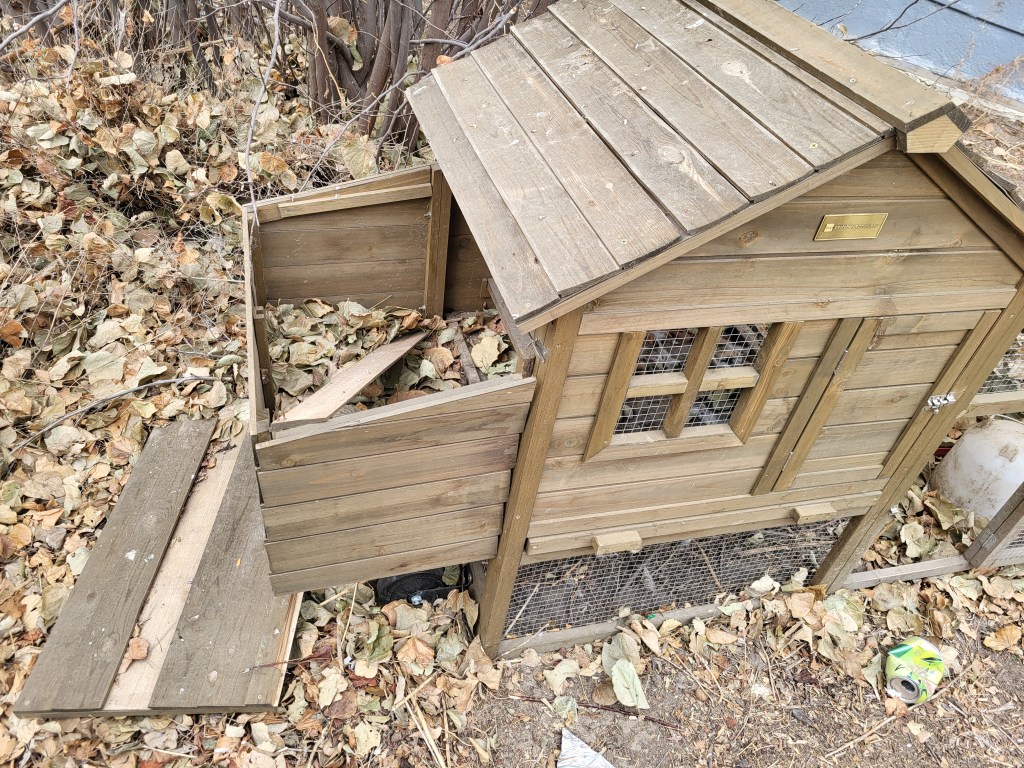
Coop after being savaged by a large dog and the wind.

Naturally, the run I’d ordered arrived a few hours after our small flock was wiped out.

If you’re not already raising chickens but want to, I encourage you to study up on coop design and protecting your flock from the elements as well as from predators. Both known and unknown ones.

If you’re already raising some, even if you are well versed and know what you’re doing, it may not hurt to go through things to make sure you’re not forgetting or overlooking something important like I did.

Twelve so far.

  Out of the 30 + large containers we was given, I have filled 12 so far. And I consider myself rather fortunate in that I’m not paying to fill them with dirt.

I’m using a technique called Hugelkultur. I have so much old wood laying around from old trees that it only makes sense to make use of it.

I start by placing a chunk of tree or other yard waste in the bottom and filling it about 3/4 of the way up with biodegradable waste. Then, topping it off with garden soil mix. There are drainage holes in the bottom.

Large piece of wood in bottom of container.
Dirt from gutter containing a lot of well rotted mulberry fruit.
Weeds from the yard added in to help take up space.

Topped off with garden soil mix and plants.

It’s amazing just how much biodegradable waste you can scrounge up to fill larger containers up with once you start looking for it. I’ve read that there are things you should not add to your raised beds/ containers. But from my viewpoint, if it it’s biodegradable, it’s fair game. I would avoid waste from cats, but for me, everything else that will biodegrade and benefit the plants and soil are fair game.

I have read a lot of facebook posts where people are filling the bottom parts of their large containers with plastic bottles, bricks, or other trash.

This is in no way, shape, or form meant to bash on those who do so but to hopefully suggest another, more natural and, in my opinion, a better healthier way to reach the same end goal.

In my case I plan on growing many different types of plants in my containers and don’t want to expose them to any more plastic waste than I absolutely have to and I want the roots to be able to reach all the way down into the soil beneath if the plant sends them down that deep.

If you’re not already familiar with Hugelkultur, I highly recommend you at least look into it. You may find it’s what you needed to up your growing, and then you may not even want to try it. It’s completely up to you. But you may at least learn something, and there’s always value in that.

https://www.almanac.com/what-hugelkultur-ultimate-raised-bed

May all your ventures be met with success!

For every step forward,

It seems there are two steps bacwards. We are making progress, though the efforst seems a bit like swimming against the current at the moment.

I had planted a little over 1,000 plants this Spring, things were growing great and a hail storm came slong and wiped most of it out. Some are making a comeback, while others are just gone.

Such is life when you’re trying to be self-sufficient. It can be discouraging to see months worth of your efforts laid to waste in a matter of minutes.

However, if you adopt the, when life hands you lemons make lemonade, arritude you’ll be better off and can usually figure out what to do to make things at least a little better.

Im our case. The tops of 100 onions were shredded, I went ahead and harvested the onion tops. Or at least what was left of them. I collected around 15 lbs worth. Still have them drying in the dehydrator.

We will make onion salt and have more than enough to add to soups, stews, and salads. I’ll even throw some in raman noodles.

I’ve ran some through the blender and found the center was still damp and nowhere near ready to be put into storage.

Though when it’s ready, I will share the end results. Maybe something will be of use to someone else.

The tops are starting to grow back on a few of the onions, so I’m hoping they will continue to grow through the season and produce nice large bulbs.

Assuming they survive and thrive, not only will we have about a years worth of onions, but there will also be another batch of tops to harvest.

Thank you for letting me blabber on, may your ventures be met with success!

Saving seeds.

We’ve had quite a few plants go to seed, and I’m happy about it. While we won’t eat some of what we grew, we will soon have enough seeds to start new many of our plants for next season.

Assuming, of course, we store our seeds properly and are lucky enough and get decent germination.

I had great results with my homemade seed tapes, so I will make many more through the winter months for things that need direct sowing. Not looking forward to winter, just thinking ahead a bit.

Of the things that have put on seeds the radishes seem to be putting on the most, the onion, bokchoy, chives, and asparagus have all put on a decent amount as well.

Onion going to seed.

The onion flower heads have a pleasant onion scent.

Radishes putting on seed.

Naturally, while waiting to get good pictures and figuring the best way of saying things so they made sense and might be helpful. We were all but wiped out by hail.

I salvaged about 15 lbs of shredded onion tops. Everything else is a wait and see if it comes back or not. It doesn’t look good, but time will tell. I’ll post sn update in a week or two.

A word to the wise, I’ve heard insect netting helps plants survive hail storms better. Next season, I will have some in place.

Thank you for stopping by, may all your ventures be met with success!