I had plans of uploading the video directly so you wouldn’t have to follow a link. Sadly however the device I recorded it with bricked on me and I’m not paying youtube for the privilege of downloading my own video.
Anyways, this shows how I prepare cans to start making heat risers for pop can solar heaters. I’ll eventually put together another video showing how to put the cans together to form the risers themselves.
I’ll also likely put out a small reasonably priced booklet if there is enough interest in such a thing.
I have posted before about my compost piles but I haven’t really said much about composting itself.
Personally I compost pretty much any and everything that will break down. Even many of the things that are not reccomend to be composted.
For meats and other things they say not to compost, I dig a hole a little deeper than needed to make sure they are at least 6″ or more below the surface. After I dump it in it is covered and then the rest of the compost pile is placed over the top of it.
I figure the the worms and bacteria will take care of it. By the time I’ll dig in that area again, it will be long gone. I should point out meats and other things they say to not compost can carry bacteria that could sicken you and or attract critters you wouldn’t want digging through your compost pile.
To be clear I’m not reccomending you do the same and if you do just be aware there are risks involved that may not work out so well for you. So research into it and know what you’re up against before even trying it.
As for normal composting I whole heartedly suggest you read up on it if you haven’t composted before and give it a go.
By composting you’ll not only eventually end up with great soil for growing plants in but you’ll also be keeping a valuable resource from going into the landfill and drawing worms and other beneficial critters. Though if things are going properly there will be critters you do not want.
Below are two links, one to composting and the last that explains the things that are good as well as bad and how to correct things. There are a lot of good videos out there as well as things things to read about composting.
Best of luck and may your ventures be met with sucess.
Last Fall the oldest boy picked up a fair amount of acorns. I figured I would try to start them come Spring.
Turns out they are not interested in waiting to grow.
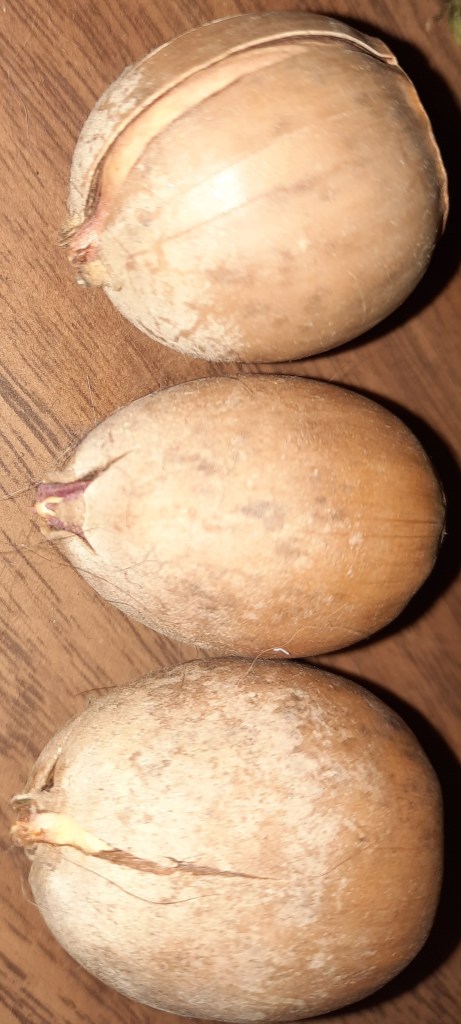
Acorns sprouting.
I’d put one in a soil block the other day. It hadn’t sprouted yet but the shell had split so I figured it at least had a chance of growing.
Today I just happened to notice roots starting to grow out of four of the acorns, most all of the rest have cracked their shells. The picture above was taken after I planted one of the ones that sprouted.
Below is one of the blocks I’m making for the acorns. I’ve decided it was time to try and get the rest to sprout.
Soil block with acorn inside. Blocker made from refried beans can with top and bottom cut out.
It would be nice if my blocks were a bit bigger, they are a nice 4″ in diameter but just a little over 3″ tall. 4″X 4″ would be better I belive. However I can find a shorter can and make a shorter block, wet the two and make the block taller.
Since I’ll be starting trees in these it seems the bigger the better. I have some 1 gallon pots that will be used to transplant the sprouts into after they get a little size to them.
I have read acorns will need to go through stratification first. However the ones that I have sprouting have not been exposed to cold and have been indoors the whole time..
However for the best chance of sucess it would be best to follow tried and true methods. Including stratification of acorns.
1. Collect ripened acorns as they drop in Fall.
2. Float test: put the acorns in a bowl of water, let sit for 24 hours. Discard the ones that float after that.
3. Put the acorns in a container/plastic bag with a damp paper towel or potting soil.
4. Check frequently for root growth.
5. Once the tap root forms the acorn can be put into a pot or other protected area after ( danger of freezing and frost are over) where it can grow for a year or two before being transplanted to it’s permanent spot.
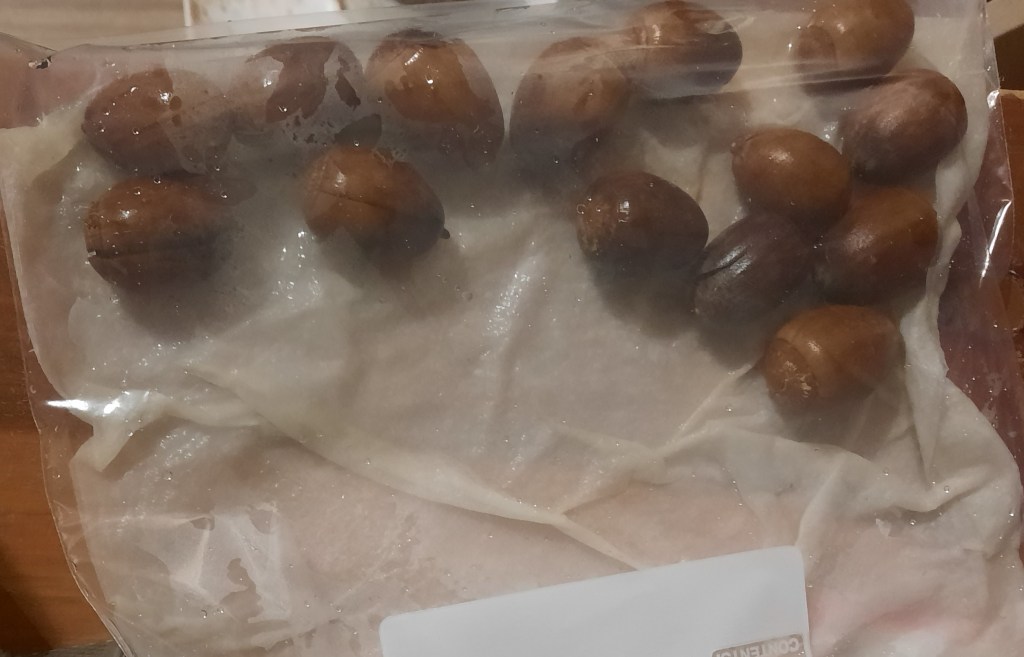
These are the acorns I’m trying to sprout now, several are showing roots. The ones in this zip lock bag were the ones that sank in the water immediately. The rest are still in the bowl, I’ll see how many are still floating tomorrow.
Acorns in 1 gallon zip lock bag with damp paper towel. Condensation shows at least some are transpiring
Three more sank and so were added into the bag. The rest were still floating, though one of them was sending out a root. Needless to say, I won’t be discarding it. I decided to experiment a little and removed the shells from a handfull of acorns, they all sank in the bowl of water. So even though it may be a waste of time, they will all be planted.
I’m also questioning the wisdom of just discarding acorns that don’t float. Since they are edible I’ll be looking into ways of preserving and storing acorns as food. If nothing else, so long as the nut isn’t bad it could be used in animal feed and if it’s bad composted.
Best of luck and may your ventures be met with sucess!
I’ve been considering a raised bed for some time now. On one hand I really like the idea on the other I have hopes of moving to a larger place and hate the thought of building only to leave it behind.
On the upside, so long as I don’t sell the property I could continue using it so I’m thinking I’ll go ahead and build it. I’d like to get a market garden set up as well as the food forest that is taking shape, though much slower that I would like.
I have tin and some used 4X4’s that I’ll use to build the bed, and I have what remains of a huge tree that was cut down a little over two years ago or so and I also have a huge amount of tumble weeds that will be broken down and used for filler.
My smaller compost pile will also likely be used to help fill the bed in. It was only started towards the end of fall but all of our compostables are being deposited in it, including shredded cardboard we used to throw away so the pile is growing rather quickly. I figure it will be at the bottom with the wood.
I’ll sink the 4X4’s 3′ into the ground after painting them to protect them from rotting. I’d considered setting them in concrete but seeing as only around 3′ will be above ground and screwed onto sheets of tin and weighted down with a great deal of soil I doubt it will be necessary. If my math is correct it will take around 26 thousand lbs of soil to fill the bed.
As work progresses I’ll document it and share the results, I may even do some videos. That’s something I’d like to get better at. I have made a few now but feel I’m not very good at it which is why there are only a few so far.
I’m looking at 36″ tall X 4 foot wide and 20′ in length. So it will be considerably bigger than anything than anything I could afford to buy premade or have built for me.
If your considering building your own but not sure where to start the video link below may be of use to you.
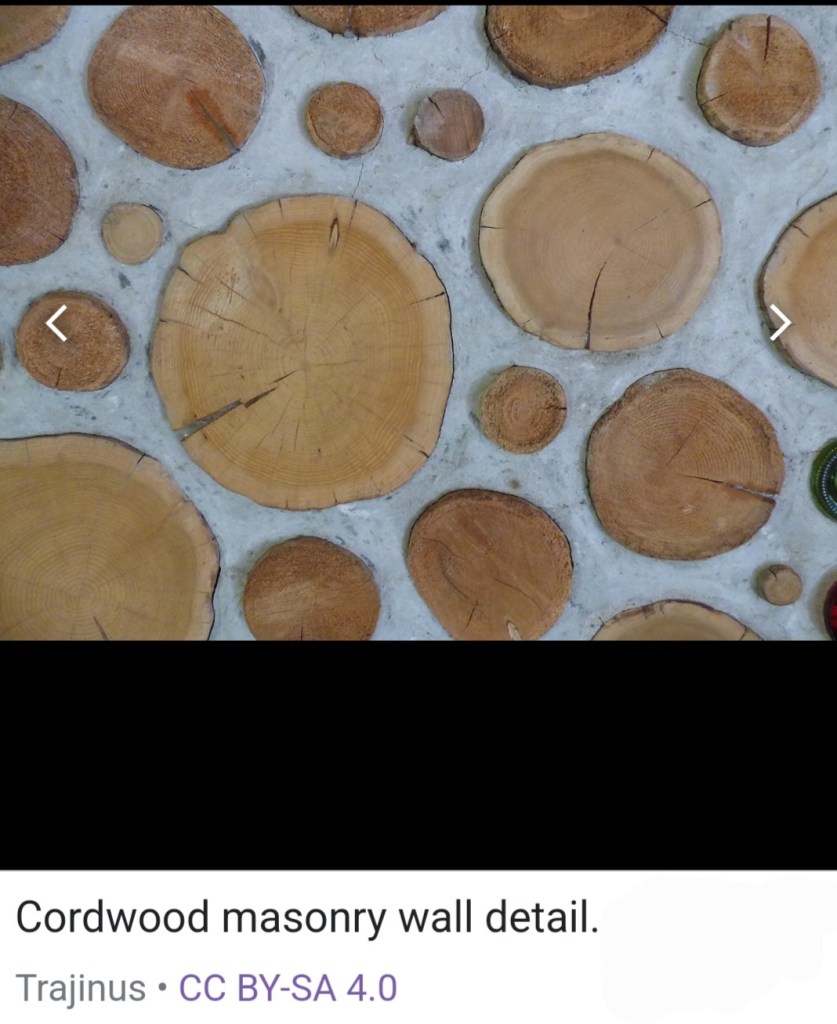
While I am certainly no expert on the subject of building with cordwood, it is something that caught my attention some years ago. I believe I saw an article on the subject in Mother Earth.
The above picture is not mine but is free to share as long as credit is given and a link to the license is provided. The link and credits are provided above.
I find the thought of cordwood construction very attractive. Mainly because most anyone can do it, not too mention it can be done relatively cheaply and at least where I live there seems to be a limitless supply of wood to work with. Assuming your willing to put forth the effort to aquire it.
From what I’ve read cordwood construction goes back around 1,000 years, or so.
As with anything there are pros and cons to cordwood construction. Below are some and there may well be others I’m unaware of.
Pros of Cordwood. . You can use small pieces .Added thermal mass .Decent insulative properties .Carbon sequestration
Cons of Cordwood: .Movement of wood can cause cracks or crumbling .End grain of wood exposed .Labor intensive .Expensive if you hire it done .Lots of wood to morter interfaces
If your considering trying your hand at or just looking into building with cordwood there are books and videos to help you along. Sadly at this point in time, this is just an interest I have and I’m highly unqualified to take a deep dive into it on here. Though I have hopes of changing that sometime this Spring or Summer. I think I may revamp my oversized dog house and see how that goes.
Below is a link that may answer at least some of your questions. And of course if you have insight or experience in the matter, please feel free to comment.
One of the simplest things to make yet they are far better than store bought.
Once you make your own you won’t want the prepackaged store bought noodles anymore. However if your like me,you may not always have the time to whip a batch up. Which is really sad because it doesn’t take all that long to do.
A decent mixer helps speed things up and make the job go smoother.
Other than that you’ll want a rolling pin, flour, salt, eggs. The last batch I made was with bean flour mixed with with a little wheat flour. Both of which were ground by hand here at home.
To be honest the bean flour was tough to grind with my little roots and branches hand crank flour mill. However the noodles were a big hit with the boys so I’ll do it again. I have a much better flour mill now. It needs a little TLC and it will be getting rebuilt come Spring. It’s a CS Bell A60 and I’ll do another video after it’s done.
To make your noodles you can use the following recipe or find another in a recipe book or online.
Ingredients
1 egg
2 Tbsp. milk
1/2 tsp. salt
1 cup white or wheat flour ( But you can use any flour.)
Instructions
1. Combine the egg, milk, and salt with a whisk.
2. Stir in the flour a little bit at a time. Keep stirring in the flour until you have a stiff dough.
3. Cover the dough with a clean dishtowel and let it rest for 10 minutes.
4. After the dough has rested ten minutes, it’s time to get out your rolling pin. Lightly flour the surface you’re going to be working on and sprinkle a little flour on your dough so it doesn’t stick to your rolling pin. Roll the dough flat (1/4″ -1/8″ thickness).
5. Let the dough rest another 20 minutes.
6. Cut your noodles into strips; You can use a pizza cutter, sharp knife or if you want to get fancy, a pasta machine. I’ve tried to use my pasta machine a couple of times but my dough has been to thick to work smoothly.
7. Lay your noodles out to dry ( I use my dehydrator. ) let them dry until they are stiff. Normally a couple of hours.
8. Package them up in an airtight container (to store in the refrigerator for a few days), or freeze them.
9. Cook them. Add noodles to a pot of boiling water or chicken soup or even make beef and noodles or chicken alfredo. Cook your noodles like store bought and mix them in and serve when done
This is a short video from when I got the A60 I don’t know if it’ll help anyone but if your considering milling your own flour to make truely homemade noodles you may find it a little useful. I must confess you can find more informative videos if you do some research online.
About four years ago, the boys and I played with making adobe bricks. Our soil is adobe and so it only made sense.
I once lived on a farm in Southwest Kansas that had a huge chicken coop that was built with adobe bricks. Knowing some of the history of the farmstead and it’s original occupants, I’m assuming they made the bricks and plastered the building themselves.
A brick the boys and I made.
The above brick is made from adobe soil with a paper pulp binder, no sand or straw. Dirt was from my front yard. It’s much lighter than the pure adobe bricks we made. It easily survived the drop test from a four foot hight onto concrete and has been left outside in the elements unprotected for the last four years.
For what it’s worth I let the pulp drain until water stopped dripping from it, I then put equal part soil and pulp together and mixed it together in a bucket by hand, until it turned into mud. I didn’t need to add extra water but you may, if you try it like I did.
We was going make enough to build a small greenhouse, however life took an unexpected turn and pretty much all plans were put on hold.
I’d picked up a brick mold online for a relatively decent price. Originally I got it to make paper bricks to burn in the fireplace. Which I tried, but it left behind far more ash than I was expecting.
The mold makes a normal sized brick and I think compressing it harder helps makes the brick stronger. Though I may be wrong.
There are quite a few videos on youtube about adobe bricks and making them, I’d suggest watching at least a few before starting, I did it on a whim and it took a bit to get it right
Once you get it down there won’t be much you can’t build with the bricks, though after building you may want to plaster over the bricks, or seal them somehow to protect them excess moisture. There are several ways of doing this so researching before making the bricks might be a good idea.
Below is a link to a video that gives some basics. If I was to make a mold like they have I would put two blocks on each end instead of only one on the parts used to compress the bricks. Or perhaps even use a few chunks of 4X4 instead instead of the short pieces of 2X4 to compress the bricks.
Once you get started you’ll figure out how you want to do it fairly quickly, if your building any sort of structure, even a dog house you should look up how to properly test the strength of your adobe bricks.
Something new to me starting last year is fermentation of foods.
Things started out great but then kind of fizzled when the heat of Summer kicked in.
At least three batches failed before I gave up for the Summer. I read up more and decided it was the heat, I don’t have air conditioning.
That being said, in my research I’d read that you didn’t necessarily have to use distilled water. So I tried a batch of cucumbers. I’m saddened to report it didn’t work out so well.
From here on out my jars, lids and springs will be throughly sterilized and I will only use distilled water. I will be distilling my own water. Seems since the pandemic distilled water has become a fast seller here.
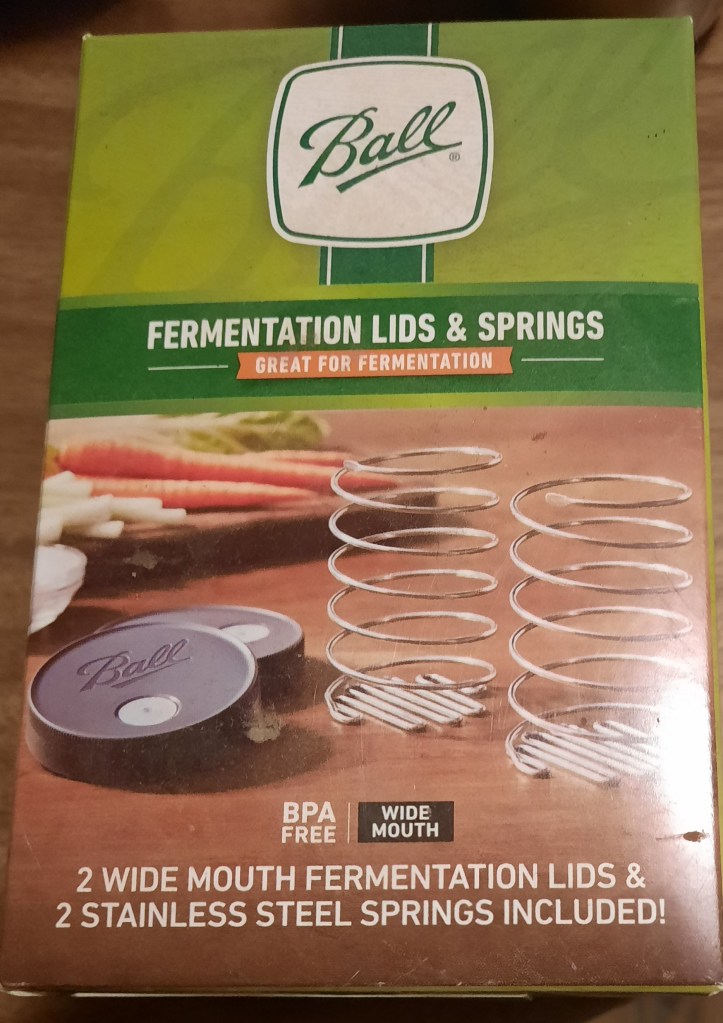
Fermentation kit from Walmart, they can also be found online as well.
From everything I’ve read fermented foods are really good for you and I like the taste. The way I see it, with things going the way they are, the more one can learn to do things the old ways the better off they will be.
I currently have a quart jar of fermented jalapenos in the fridge and I prefer the taste to store bough. It’s a bit of an acquired taste but after eating a few, all I taste is vinegar when I eat the store bought.
I’m constantly learning how to do things they way they were done before industrialization came along.
For my salt I’m using Ball canning salt, it’s finer than table salt, however most all the videos I’ve watched say they are using sea salt. Something I can’t get locally.
I’ve included links to two videos that may be helpful to you if your wanting to try fermentation at home. The first link is on fermentation and the second is about making your own distilled




 Slocum's Creak
